Sunday, February 24, 2013

Project #10 Finding the Right Tool

My major is Elementary Education. Although I do not know what specific grade I would like to teach yet, I wanted to try and find a fun site that would be able to cover all subjects taught in k-3rd grade. So that my students would be able to review by playing educational games or watching videos on how to break down problems step by step. I started searching and came across a web site called BrainPOPJr. This webpage covers all subject areas such as: Science, Health, Reading & Writing, Social Studies, Math, and Art & Technology and more. The only down side is BrainPOPJr. is not free.

How would I use this in my classroom?

  1. I can show the videos and do activities as a class using a white board or smart board.
  2. Students can do these activities at home to help review and study for test
  3. I can use the accompanying lesson plans to help plan my lessons 

Friday, February 22, 2013

Blog Post #6

The Networked Student


This video is about a high school student that is studying Psychology. He is in a class where his teacher barely does any lectures and the class is essentially a green classroom, meaning there are no books or paper required. All of the work, reading, and assignments are online. The student's teacher is a student of connectivism. Connectivism simply means that learning occurs as part of a social network of many diverse connection and ties. The teacher empowers her students to take charge of their own learning and to make connections with others who will strengthen their learning process. 

The student starts off by making a PLN (personal learning network). He finds valid sites about his topic of study by using Google scholar and the school's library data base. When he finds sites that are worthy, he post them to his social bookmarking sites. Next the student creates a blog where he takes his knowledge of Psychology and shares his opinions with the world. The student also learns that through iTunesU he can access thousands of courses recorded by actual professors.

Why does a networked student need a teacher?
A networked student such as this Psychology student needs a teacher for guidance. 

Students need teachers so that they can effectively learn how to access all kinds of information that technology has to offer. It's our responsibility as teachers to show our students how to communicate properly, how to differentiate good information from bad, to be respectful of others, and to help students organize all their information and how to apply these skills for their future. 


I am truly impressed with this video. Her PLN looks to be like mine for EDM 310. However, I do wish I was able to be educated on things such as PLN when I was going through middle school, even high school. This seventh grader has a bright future because she is in touch with all the latest technologies and knows how to use them properly and effectively thanks to her teacher! It is engaging for students and it's a new way to stay organized and teach students how to become responsible. 

Sunday, February 17, 2013

Project #6 "This Is My Sentence" Video

Blog Post #5

If I Built a School

Krissy Venosdale has been a teacher for ten years and is currently teaching special education. She is very creative and full of life. Her blog, Venspired was inspired by her students and the continuous learning that occurs in her class daily.

Her blog post, If I Built a School was very creative. In this post she talks about her dream of building a school. It starts with her receiving a letter from someone extremely wealthy. In this letter, there is a post-it note that reads, "Follow your dreams, and build a School." Mrs. Venosdale then begins to paint a beautiful and elaborate picture of what her school would be like. She explains how "creativity would be oozing out from every pore", that there would be colorful walls, comfy seats, nooks, and crannies where every student could collaborate, discuss, and dream. How every room would be state of the art, with all the latest technology! She would have a school bus ready at all times to take the students on unlimited field trips, when necessary. My favorite part was when she reveals that she would have a tree house in the Library! What better way to inspire children to read than that!

I share some of these same ideas with Mrs. Venosdale when it comes to building my own school. I don't know all the ins and outs of making a school but I do know that I would create a place that is bright and colorful with classrooms that have all the latest technology, which would be at the students disposal at all times. The students will also be allowed to pick the theme of each classroom and decorate them accordingly with their crafts and art work. All the students would sit in big comfy computer chairs at their own individual desk. I would make sure that my school is on the outside of town so there is peace and quiet, so that there could be beautiful gardens and trees where hammocks would hang from so that students would be able to read, collaborate, and relax. My cafeteria would have top culinary chefs that would prepare healthy food for the students and faultily and for my Library I would also have a tree house along with big comfy couches and bean bags.

Eric Whitacre's Virtual Choir

This video is amazing. I would have never imagined something like this would be possible. Eric Whitacre got the idea of starting a Virtual Choir from a friend who emailed him a link of a fan singing one of his pieces called Sleep. After listening to this fan sing he immediately got the idea to get people from all over the world to send in videos singing his pieces so that he can put them together to create a Virtual Choir. For his first Virtual Choir he took 185 individual voices from 12 different countries that have never met and put them in harmony with one another. The piece was very beautiful and innovating.

Teaching in the 21st Century

I agree with Kevin Roberts's position on this video. Due to all social media, such as: Blogs, Facebook, Twitter, YouTube, cell phones, Google, etc. being able to access where ever you are, whenever you want is a drastic change from where we use to be a decade ago. He is pointing out how important it is for all teachers to be technological literate because "teachers are no longer the main source of knowledge, we are the filter." And as a future educator it is my job to be able to teach my students how to use these resources correctly.

Flipping a Classroom

This is a great and innovated way of teaching. I love how this helps out all students on every level in math, whether they are lower-level students, mid-level students, or higher-level students. Flipping allows students to move at their own paste, and also allows them to have control over the lesson by, stopping the video, rewinding and playing back key parts, or even fast forwarding. It's also great for parents that want to be more involved in what their child is learning in Math at school. These videos , Why I Flipped My Classroom and Flipped Classroom - FAQ by Katie Gimbar are very helpful and shows a new way to teach students math.


Sunday, February 10, 2013

Blog Post #4

Podcasting with First Graders


Podcasting addresses the following skills:

  • listening
  • speaking 
  • presenting 
  • comprehension 
  • story telling 
  • performance 
  • voice acting 
  • oral fluency
  • media 
  • technology


Silvia Tolisano is right when saying, "Believe it or not, but having an audience matters... even to six year olds."

She started off by picking a book that her class would enjoy reading called, Vacation under the Volcano by Mary Pope Osborne from the Magic Tree House series. She broke down the book by chapters and discussed it as a class, then she had her students come up with questions and answers. Once the whole book was completed the students were rotated and recorded so that each student participated. Silvia Tolisano's results were amazing. The students paid attention to what was going on the whole time and were really interested in editing parts of the podcast. My favorite part about her findings was when she mentioned that the shy students were fully engaged as well and "coming out of their shells."

1st Graders Create Their Own Read-Along Audiobook

Teaching first graders how to podcast is amazing. I enjoyed listening to all their books they recorded. I could hear in their voices how excited they were. The students were fully engaged in the activity and were very creative when bringing their characters to life. This is a new and inspirational way to get all students involved with reading even for the students who don't like to read. Recording the student's voices will encourage students to want to read better. Also, creating a booklet is a definite plus for the students so that they are able to follow along.

Listening-Comprehension-Podcasting

I loved this post from Silvia Tolisano's blog because she fully explains why it's important for younger students to learn about podcasting. That in order to learn a new word a student must review the word multiple times and listen to the context it was written in. Silvia points out that tone matters when teaching students new words. That the words surrounding the definition as equally important as the word being learned.


Project #5 Presentation

Saturday, February 9, 2013

C4T #1

I was assigned Mr. Will Deyamport, creator of peoplegogy.com.


Blog Post #1
Google+ in the K-12 Classroom

In this post Mr. Deyamport discusses four ways to use Google Hangouts in the classroom. He elaborates on how you can use Hangouts to help your class become more engaged and interactive with lessons taught in your classroom. The four different ways he talks about are: World Cultures, Novel Studies, College readiness, and Summer Programs. 

A Google Hangout is a free group chat feature which allows users to set up a video chat room!

Through World Cultures he gives an example of how you can choose a country of study and set up Hangouts with students from that country, also how teachers could use Hangouts with Museum Directors and people who have ties with the country or area of the class is studying. With Novel Studies, Mr. Deyamport recommends using Hangouts with other classes across the Country who are discussing the same books as your students, by assigning your students to discuss the plot, character development, and theme. Under college readiness, he recommends using Google Hangouts to talk to college counselors and college students. And last Mr. Deyamport talks about using Hangouts for summer programs, such as having your students meet through Google Hangouts rather than the classroom.

Comment #1


I started off by introducing myself and telling him how much I enjoyed reading his blog. I did mention that I wasn't quite sure what a Google Hangout was so I clicked on his link he had from YouTube, to view a Hangout from a Master Class. It was really neat. It reminded me of an updated and improved version of Skype.

Blog Post #2
Who did I meet at MECA 2013? Eric Sheninger

MECA stands for Mississippi Educational Computing Association and is held in Jackson, MS.


Eric Sheninger is a principle at New Milford High School located in Bergen County, NJ. He was a guest speaker at MECA 2013. Mr. Deyamport starts off by saying he met Eric Sheninger on Tweeter three years ago. They became friends and that Eric Sheninger was very supportive of his work. Mr. Deyamport goes on to talk about Mr. Sheninger's speech at the convention and post a video of him speaking on how he uses social technologies to engage and enrich the learning experiences of the students at his school. Then he lists all Eric Sheninger's accomplishments, which were quiet fascinating.

Comment #2

I started off by saying I was glad he enjoyed his visit to Mississippi and glad that he finally got to meet Eric Sheninger in person, and that since he spoke so highly of Eric Sheninger, I decided to visit his webpage to learn more about him. I watched most of his videos that were posted. I was impressed with how far he has come since 2009 just by simply having the willingness to learn.  

I would highly recommend viewing his webpage (http://ericsheninger.com/) look around a bit. He has some great ideas and inspirational videos.  


Wednesday, February 6, 2013

Special Blog Post #1

WolframAlpha

Many students misinterpreted Dr. Strange version of Did you know?, including me. I didn't take in to consideration the difference in population. When I searched the different populations of China, India, and The United States I found that China has a population of 1.21 billion, India has 1.35 billion, and the United States has 309 million. China and India has a significantly bigger population than the United States, which if you don't pay attention it explains why anyone could easily take it as the United States is "falling" behind, but we are not.

I did two more searches on WolframAlpha. The first question I searched for was which state has the largest population? The answer was California with 37.69 million people. I wasn't surprised by the answer however; I was surprised by how much extra information popped up from my search. It gave the basic information, location, population history, statistics, and all the main information about the state of California. The second following question I asked was which state had the smallest population? This turned out to be Wyoming with a population at 568,158 people.

Gary Hayes Social Media Count


I enjoyed looking at this site. It's really neat how Gary Hayes was able to put together a page where it instantly updates everything that is going on with social media around the world. I was blow away with the numbers for each different option I chose, because I have never seen everything compared like this before.

Watching the numbers increase at such a rapid rate really shows you how fast the world is changing and how important social media is the world. I believe that it is important to expose my students to different types of social media. There is a lot of going on beyond the four walls of a classroom. Having my students be exposed to everything that is going on through social media will help them go above and beyond with all subjects.

Monday, February 4, 2013

Blog Post #3

Peer Editing

I am very thankful for Paige Ellis' Blog Assignment and for sharing it with Dr. Strange. I have had some bad personal experiences when it comes to being corrected by my peers. I am not a very strong speller and I have had classmates of mine in the past that have made me feel very uncomfortable and embarrassed for my mistakes. This is why I have always been very hesitant when it comes to correcting one of my peers. I am afraid that I will come off rude. Plus, I never quite knew the proper way how to handle correcting someone's mistakes until now. 

I learned a lot from watching these videos. I learned how to present myself in a positive manner when correcting someone's work. First, always remember to start off with giving compliments. The next thing to do is to give suggestions, and not to be afraid to do so if needed and last, finish by giving the actual corrections.

Assistive Technologies 

My heart has always hurt for those who are unable to see because they do not get the same opportunities as people who do that can. They have been limited in the past because of the lack in advance technology. However, thanks to brilliant and creative people like Art Karshmer at The University of San Francisco, who make it is possible for blind students to succeed in subjects that they were unable to before such as math. His touch pad allows blind students to be successfully educated in math, from basic beginner problems all the way up to beginning Algebra! The iPad with voice audio and the Braille writer are also brilliant new advancements that allow blind students to interact with their classmates and experience learning as their peer's do, that do not suffer from being blind. 

All technologies should be welcomed in a classroom. It is our job as teachers to use every available resource to educate our students no matter their disability. The iPad voice audio allows blind students to be able to research, read, take notes, etc. this will be a must have in my classroom. Plus, I think that it is important to have these resources available so that parents, guardians, and other students can learn to operate them as well so that they are able to aid him/her if needed.


I loved this video! I like how she is not afraid to teach her students new software and exposes them to different media tools. I also like how she is introducing her students to a world beyond the four walls of her classroom. By watching the video and watching her students interact and helping one another you could tell that they were all interested in class and looked like they were having fun. Also, she is very hands on, which I like. 

The one thing that she did say that really stood out to me was, "I don't have to define everything...; they should be thinkers". A teacher's job is not to give the students all the answers to everything. It immediately reminded me of the "burp back" education example that Dr. Strange gave to us on the first day of class. I also noticed that her classroom was full of high school students, which is awesome. I wish I had a class like this and a teacher like Mrs. Davis that I was required to take back when I was in high school. 


Sunday, January 27, 2013

Blog Post #2

Did you know?

In Did you know? 3.0- A John Strange 2012 version, Dr. Strange outlines the original video by Karl Fisch and Scott McLeod. In his outline Dr. Strange discusses statistical facts such as, "Twenty-five percent of the population of India with the highest IQ's outnumber the entire population of the United States." Or that India has more K-12 honor students than all of the K-12 students in the United States. However, the one that surprised me the most was, "By 2025 the number of English speaking Chinese is likely to exceed the number of native English speakers in the rest of the World!"

These statistics are mind blowing to me. I watched the video several times and each time I watched I became more and more amazed with what was going on in our world.
The one thing that really grabbed my attention was, we are preparing students to use technologies that don't exist yet! It is a little bit intimidating if you ask me, but I am definitely up for the challenge.

Mr. Winkle Wakes

In Mathew Needleman's video, Mr. Winkle Wakes it talks about Mr. Winkle waking up from a one hundred years slumber in a business building where people are using computers and phones to contact people and do business transactions on. He begins to get sick, so Mr. Winkles walks to the nearest hospital in which he finds himself in a place full of advance technologies. He sees Machines that are helping to keep humans alive and taking pictures of their bones. Overwhelmed with all this advancement, Mr. Winkle remains sick. He then leaves the hospital in search of a school. When he finds the school he immediately starts to feel better. He was happy to see that the students were in neat rows in the classrooms learning all day, "that some things do not change".

I found this video very strange. However, it did have a good story behind it. It made me realize how far we have advanced in technology over the century as far as hospitals and businesses.  That people back in the day had it a lot harder than what we do today. They didn't have all the luxuries of life that some of us take for granted nowadays.

Although the one thing that stood out to me was Mr. Winkle became well when he entered the school? The video gave me the impression that we haven't advanced enough in the classroom. I beg to differ. I do understand that we do still use pencils and paper but we have made plenty of advancements as well. Teachers are teaching their classes from smart boards instead of chalkboards and we are using computers for research instead of books from the library.
 
Sir Ken Robinson: The Importance of Creativity

In Mr. Robinson's video, The Importance of Creativity, he made some very eye opening points. He talked about how creativity is as important as literacy. Which is true, our society has developed a hierarchy in which creativity and arts are pushed to the side and the only thing that matters are "core" subjects, such as, math and science. The problem is that we don't grow out of being creative; we are educated out of it.

I agree with this! I enjoy math and science. However, I am lacking in creativity. I wish that my teachers would put more of an emphasis on arts. It's important to make such that you mold children into well rounded students. This will be something that I will work hard to maintain as an educator.

Pinterest  

I love Pinterest! Although this is the first time I have created my own account. Normally I use my sister's account. I will definitely be using Pinterest in my classroom. It will help keep me organized for class projects and crafts. Since I am not that creative, Pinterest will help me out where I lack.

As of now, I will be following Kristen Brynteson. Hers appealed to me the most, although I will be going back through each one later on because there was so much to look at. I have lots of exploring to do now that I have my own account! Plus, she had some great educational resources and apps that looked to be helpful.


Sunday, January 20, 2013

Blog Assignment #2

About Me

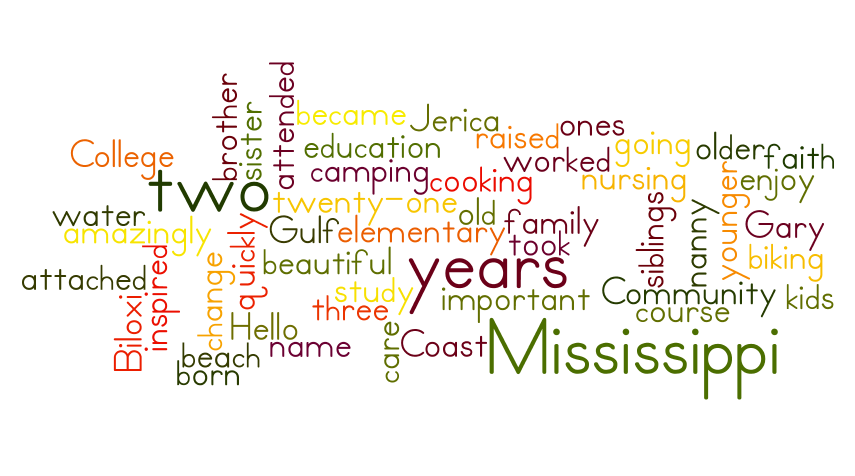
Hello! My name is Jerica Gary. I was born and raised in Biloxi, Mississippi. I am twenty-one years old and have two siblings, an older brother and a younger sister. My family and my faith are both very important to me. I enjoy cooking, camping, biking, going to the beach, and being out on the water. 

I attended Mississippi Gulf Coast Community College for three years and while I was there I worked as a nanny. I took care of two amazingly beautiful kids in which I quickly became attached to. They are the ones that inspired me to change my course of study from nursing to elementary education. 

My Future Classroom 

When I was growing up I was very shy. I felt uncomfortable being in big groups. However, that ended in my third grade year when I was introduced to group activities by my teacher Mrs. Warren. She was full of life. She kept learning structural and fun and her teaching methods where very engaging as well as hands on, which changed my life for the better. I became more outgoing and more eager to participate in class. 

So when I think of my future classroom, my third grade class is what I flash back to. I aspire to be like Mrs. Warren and give my future classes the same experience each year that I got with my third grade class. 

I plan to teach anywhere between grades one through four. My room will be vibrant and inspirational, full of life and color. I will be versatile when teaching new curriculum.  I will do that by introducing new concepts through music, games, or crafts. I will be incorporating a lot of group activities. This will help my students to be more sociable (if needed), learn how to work well with others, and be able to expand their minds to go above and beyond.

I would also love to have a class pet, in which my students will be responsible for. I believe that it is important for children to have responsibilities at a young age. Positive reinforcement is another key element I will be using in my classroom; encouraging my students to think outside the box and to push beyond their own boundaries.   

Randy Pausch on Time Management

In Dr. Pausch's video I learned that time is just as important as money. Also when there is tasks at hand NEVER take short cuts. However, the one thing he mentioned that I really need to work on is, when making a to do list always do the ugliest task first. I always tend to get the easier task done and save the harder one for last.